Thailand’s royal barges combine sculpture and seamanship with distinct ceremonial roles. A swan or a multi-headed naga gives a vessel an identity beyond its name. Official collection records also distinguish what different barges carry, linking their appearance to the purposes of court ceremony. [1]
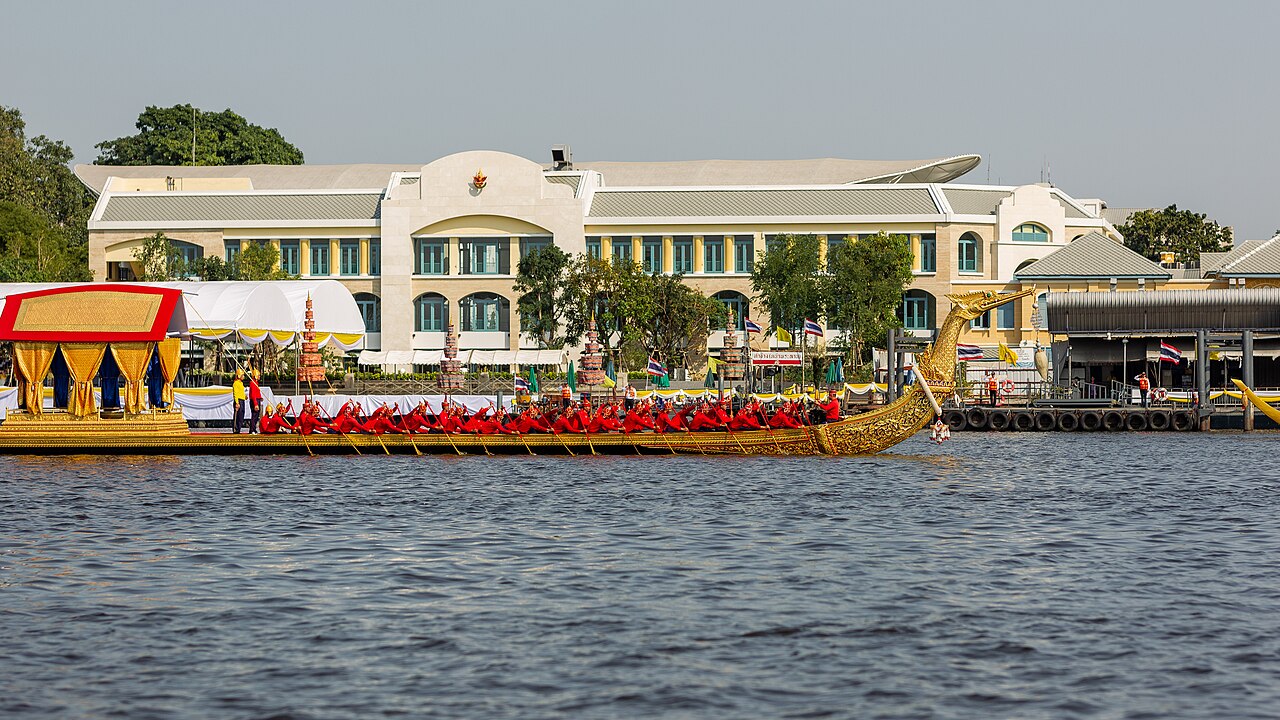
Suphannahong offers a clear starting point. The Royal Barges National Museum dates the completion of the surviving vessel to 1911, in the reign of Rama VI, following work begun under Rama V. Its name recalls earlier royal barges. A swan’s head rises at the bow, while the long hull forms the bird’s body. The museum describes carved wood finished with lacquer, gold and glass decoration, with a hanging tassel whose tip carries a crystal ornament. [2]
The decoration surrounds a working ceremonial vessel. The museum’s account includes a central royal seat, called the Kanya throne, for the monarch or senior royalty. It also records a chant leader, whose calls are answered by the oarsmen in rhythm with other boats. That detail adds an audible dimension to the familiar image: the craft includes coordinated human performance as well as the carved and decorated surfaces that survive in photographs. [2]
Narai Song Suban King Rama IX uses a different figurehead. The Sirindhorn Anthropology Centre’s art database describes four-armed Narayana mounted on Garuda, with a crown and divine attributes. Carving, lacquer, gilding and glass mosaics form its artistic vocabulary. The record identifies blue glass decoration, a red hull with flame and plant motifs, and a central Kanya throne. The imagery distinguishes this vessel from Suphannahong’s swan form. [3]
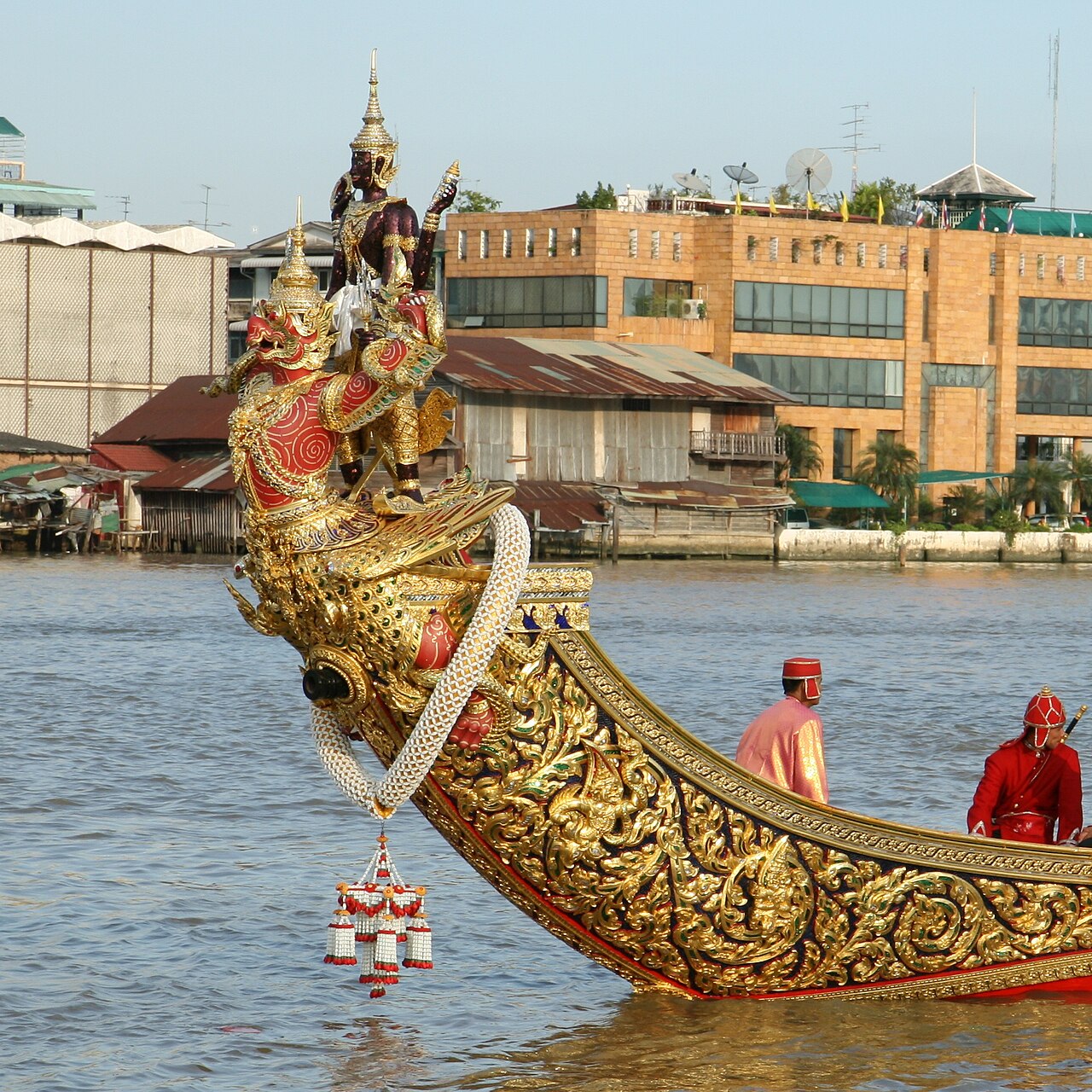
The same institutional record separates the practical and artistic responsibilities involved in creating Narai Song Suban: the navy handled the hull, paddles and rudder, while the Fine Arts Department undertook the decorative work. It is a concrete example of the technical and artistic collaboration behind the barges. [3]
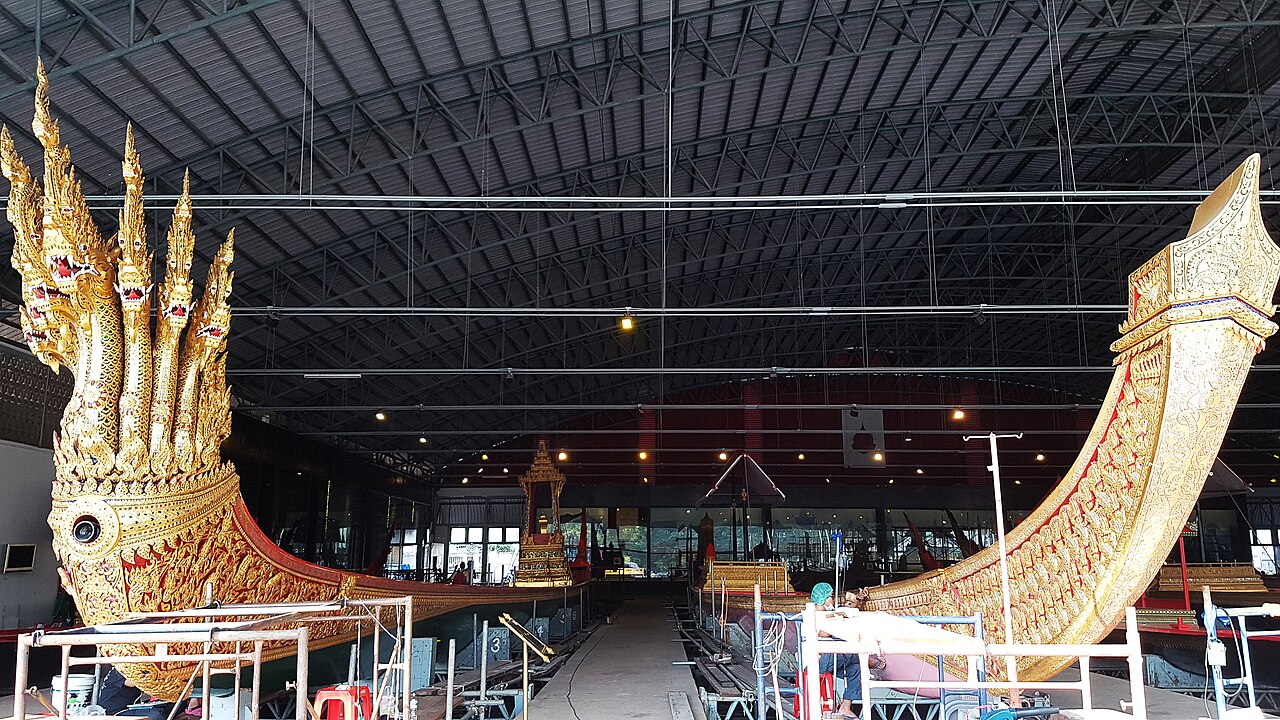
Ceremonial purpose also distinguishes one boat from another. The Fine Arts Department describes Anantanakkharat as having a seven-headed naga figurehead and a role carrying important Buddha images or Kathin robes. Anekkachatphutchong, by contrast, bears many small naga figures in its carved, gilded decoration. Treating every barge as interchangeable loses the relationship between its appearance and its place in court ceremony. [1]
Kathin provides part of that religious context. In its background account, the Tourism Authority of Thailand describes the annual Buddhist observance following the end of Buddhist Lent, when robes and other offerings are presented to monks. A monarch’s participation makes it a Royal Kathin ceremony. TAT characterises the barge tradition as a combination of formal ceremonial practice, naval skill and craftsmanship. In that account, the barges connect the practical work of moving a ceremonial party by river with an observance centred on gifts to monks. [4]
Preservation is another part of the story. A Fine Arts Department history says the museum developed from a barge dock and storage complex. Bombing damaged the dock and some vessels during the Second World War; the department subsequently undertook their repair and care. The dock became a national museum in 1974. Beside Bangkok Noi canal, the collection’s home preserves the connection between its boats and a working waterway. [1]
A historical overview published by the department interprets ceremonial processions as developing from older naval formations and peacetime training, accompanied by decorated boats and music. It also traces royal river travel through successive Thai capitals. Seen against that history, the barges invite several kinds of attention: to the identity of a figurehead, the work of specialist craftspeople, the coordination of a crew and the purpose of a ceremony. Each offers a distinct way to understand the vessels beyond their visual splendour. [5]
What to know
A closer reading of the royal barges starts with the differences between the vessels: their figureheads, craftsmanship and documented ceremonial roles.
About this reporting
Prepared with AI assistance using the sources cited below.
Corrections & updates
: Added licensed historical photographs of the barges discussed in this article; reporting text is unchanged.